There’s a big El Niño brewing this year, and CCR scientists have developed one of the most skillful El Niño forecast models in the world. With scientists at NOAA, CCR Prof. Daniel Vimont developed the model to better understand how the ocean and atmosphere interact in producing El Niño events. “In 2023 we noticed that the model does an outstanding job simulating the seasonal evolution of El Niño events, which tend to peak around December. So, we decided to develop a realtime forecast model and document its skill. It produced a nearly spot-on forecast for the 2023-24 El Niño event nearly a year in advance.” Vimont, together with graduate students Jaf Kongkaeo, Katelyn Reagan, Ally Vizcarra and Jack Zweifel, has recently documented the model skill and made the source code publicly available. This model is now being regularly used by El Niño forecast communities, including at the NOAA Climate Prediction Center. The UW-PSL CSLIM forecasts can be found at the International Research Institute’s ENSO Forecast page at https://iri.columbia.edu/our-expertise/climate/forecasts/enso/current/ .
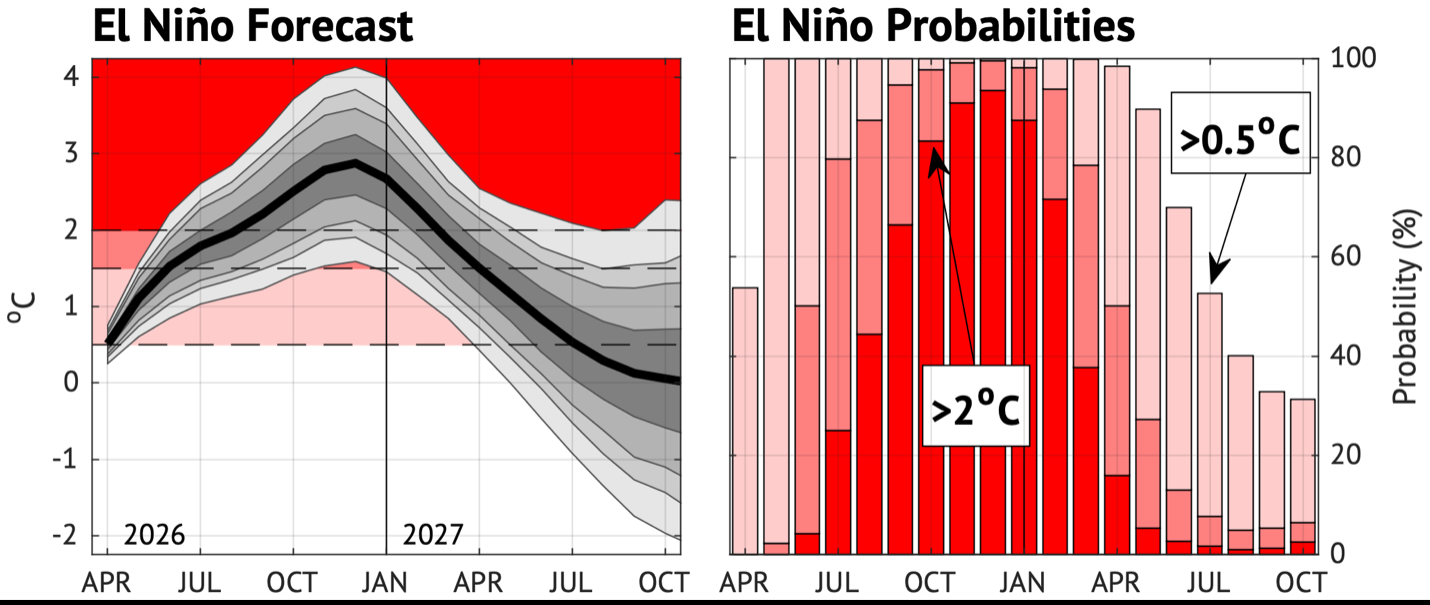
El Niño Forecast from April 2026. The dark black curve shows the forecast for the Niño3.4 index, which is used to describe the strength of an El Niño event. For reference, a “Super El Niño” occurs when the Niño3.4 index exceeds 2°C. The right panel shows the probability of an El Niño event (Niño3.4 > 0.5°C; light pink bars), the probability of a “Strong El Niño” (Niño3.4 > 1.5°C; light red bars), and the probability of a “Super El Niño” (Niño3.4 > 2°C; dark red bars).